Wednesday, March 19, 2014
Living Like Parasites
Putin said of America, "They are living like parasites off the global economy and their monopoly of the dollar."
Putin understands something that few do.
Imagine half the dollars are outside the USA and half are in. Then imagine $1 trillion new dollars are made and owned by the USA. No real new value is made when this new $1 trillion in money is created. Eventually all the existing money will be reduced in value because of this new money. Half of this stolen value comes from reducing the value of the money outside the USA. So in effect the USA has sucked $500 billion out of the rest of the world. Living like parasites is a good description.

Sunday, March 9, 2014
The Threat of Dumping Bonds
When the British, French, and Israelis attacked in the 1957 Suez Crisis, America was able to put financial pressure on Britain. It held many British bonds and threatened to start selling them if the British did not stop the attack. From the Wikipedia article:
"Britain's then Chancellor of the Exchequer, Harold Macmillan, advised his Prime Minister Anthony Eden that the United States was fully prepared to carry out this threat. He also warned his Prime Minister that Britain's foreign exchange reserves simply could not sustain a devaluation of the pound that would come after the United States' actions; and that within weeks of such a move, the country would be unable to import the food and energy supplies needed simply to sustain the population on the islands."
Some say this marked the end of the British imperial power and the start of America as a "superpower".
Now Russia is threatening to dump US bonds if the US imposes sanctions on Russia for Crimea.
Hum.
Friday, March 7, 2014
Scientific Theories Make Testable Predictions
A common criticism of "people who believe in hyperinflation" (as if it was like the Tooth Fairy) is that we can not reliably say when it will start. You can see this at Cullen Roche, Scott Sumner, Mike (Mish) Shedlock, and Paul Krugman. Several of these have had many posts of the form, "ha, ha, I have been right so far". However, I have not been able to any real debate from these people over the theory of hyperinflation as in Hyperinflation FAQ and also Hyperinflation Explained in Many Different Ways.
The average paper money seems to last about 25 years. Big developed countries pull this average up, but even America has had hyperinflation a couple of times. But for discussion, lets assume hyperinflation happens 1 out of every 25 years in the average country. This means that 24 out of 25 years there is no hyperinflation. Someone who just says, "no hyperinflation this year" is like a stopped clock that is right 96% of the time. And still they are so proud. :-)
Just to be very clear, if these people don't switch to "there will be hyperinflation this year" right before the hyperinflation starts, then I claim that in all their previous predictions of "no hyperinflation this year", they were just being stopped clocks.
I also like to point out that when you go from 2% inflation to 26% inflation, 30 year bonds will lose 99% of their real value. So it is better to be many years early than one year late in getting out of bonds if hyperinflation is coming.
Still, there is some truth to this criticism. A scientific theory makes testable predictions. A good theory should make predictions that turn out right. Not looking to debate if The Dismal Science is a real science.
With my many explanations of hyperinflation we have many good theories of how hyperinflation works. In general there is a feedback loop. But most of these theories don't give us much clue about when the feedback loop will start. The timing is not really part of these theories.
However, one of these does have timing information. The backing theory of hyperinflation. This says that the central bank has to have reserves to support the value of the currency. If the central bank is burning through these reserves at a rate where they run out after a certain time, we have some handle on the timing. They may prop up the value of their currency till they are almost out of reserves, but that is it. There will be a day of reckoning. We can estimate when by how long till they run out of reserves.
When the Argentine government took much of their central bank's reserves, I said to myself that they were headed for hyperinflation. A reader of this blog pointed out that the Ukraine's central bank did not have enough backing and so seemed headed for hyperinflation. Both of these were based on the backing theory of hyperinflation. So to me the backing theory of hyperinflation seems a very good way to predict timing for hyperinflation. So I would like to try to do this in a public way. Clearly predictions made in public are far more impressive.
For me the interesting prediction is when a currency will go from something normal like 2% inflation to 26% or higher yearly inflation. There are also many more making this transition than those that go all the way to 50% per month.
Do any readers have an ideas for countries that now have moderate inflation but where the central bank reserves per note issued are far below the current value of the note? A government running a big deficit has a harder time bailing out the central bank, so that is an important factor as well. In fact, it is prbably reasonable to just look at foreign reserves if the government has a large deficit, ignoring government bonds.
I will update this post trying to make an ordered list of hyperinflation candidates.
The central banks in the big reserve currency countries seem to have lots of long term bonds in their own currency. It would be nice to know how much these would drop in value as interest rates went up. Like if Japan's interest rates go up 2% what does that do to the value of the central bank's reserves?
I have an earlier post on ideas for predicting the timing of hyperinflation.
The average paper money seems to last about 25 years. Big developed countries pull this average up, but even America has had hyperinflation a couple of times. But for discussion, lets assume hyperinflation happens 1 out of every 25 years in the average country. This means that 24 out of 25 years there is no hyperinflation. Someone who just says, "no hyperinflation this year" is like a stopped clock that is right 96% of the time. And still they are so proud. :-)
Just to be very clear, if these people don't switch to "there will be hyperinflation this year" right before the hyperinflation starts, then I claim that in all their previous predictions of "no hyperinflation this year", they were just being stopped clocks.
I also like to point out that when you go from 2% inflation to 26% inflation, 30 year bonds will lose 99% of their real value. So it is better to be many years early than one year late in getting out of bonds if hyperinflation is coming.
Still, there is some truth to this criticism. A scientific theory makes testable predictions. A good theory should make predictions that turn out right. Not looking to debate if The Dismal Science is a real science.
With my many explanations of hyperinflation we have many good theories of how hyperinflation works. In general there is a feedback loop. But most of these theories don't give us much clue about when the feedback loop will start. The timing is not really part of these theories.
However, one of these does have timing information. The backing theory of hyperinflation. This says that the central bank has to have reserves to support the value of the currency. If the central bank is burning through these reserves at a rate where they run out after a certain time, we have some handle on the timing. They may prop up the value of their currency till they are almost out of reserves, but that is it. There will be a day of reckoning. We can estimate when by how long till they run out of reserves.
When the Argentine government took much of their central bank's reserves, I said to myself that they were headed for hyperinflation. A reader of this blog pointed out that the Ukraine's central bank did not have enough backing and so seemed headed for hyperinflation. Both of these were based on the backing theory of hyperinflation. So to me the backing theory of hyperinflation seems a very good way to predict timing for hyperinflation. So I would like to try to do this in a public way. Clearly predictions made in public are far more impressive.
For me the interesting prediction is when a currency will go from something normal like 2% inflation to 26% or higher yearly inflation. There are also many more making this transition than those that go all the way to 50% per month.
Do any readers have an ideas for countries that now have moderate inflation but where the central bank reserves per note issued are far below the current value of the note? A government running a big deficit has a harder time bailing out the central bank, so that is an important factor as well. In fact, it is prbably reasonable to just look at foreign reserves if the government has a large deficit, ignoring government bonds.
I will update this post trying to make an ordered list of hyperinflation candidates.
The central banks in the big reserve currency countries seem to have lots of long term bonds in their own currency. It would be nice to know how much these would drop in value as interest rates went up. Like if Japan's interest rates go up 2% what does that do to the value of the central bank's reserves?
I have an earlier post on ideas for predicting the timing of hyperinflation.
Thursday, February 13, 2014
Preventing Crises
If since the USA was founded they had required banks to sell 10 year bonds to
get the cash to use for 10 year loans (banks can't use demand deposits, must have
matched duration bonds and loans, so no fractional reserve banking or "bank made money") and never
went off a gold/silver coin money (no paper money or central bank) then I
think that there would not have been anywhere near the number of
inflations/booms/busts/deflations/financial-crises between then and now. If
regular banks and central banks can increase or decrease the money supply, then the
money supply is not stable, and you get booms and busts and crisis after crisis.
This is sort of my version of the Austrian Business Cycle Theory. I think it is easier to think about in terms of central bank made money and private bank made money not being stable, so nothing is. Fractional reserve banking is the core cause of financial crises and the reason people think they need a central bank to act as a lender of last resort. If you did not have fractional reserve banking, then you would not need a central bank and could have a much more stable money supply and financial system.
For more than 2,000 years an ounce of gold has been about the value of a nice suit, shoes, and belt. This is amazing stability. The median life expectancy for defunct paper currencies is only 15 years. Even in the big stable countries paper money loses more than 90% of its value in under 100 years. In the 1950s a silver dime was about the value of a gallon of gas and 1/10th of an ounce of silver is still around the value of a gallon of gas but the US dollar does not buy anywhere near as much gas it could 60 years ago. Paper money does not come close to the stability of gold and silver. Paper money and fractional reserve banking together is a recipe for financial disaster.
Keynesians think that if we just make more money we could avoid the pain of the bust. However, this can lead to hyperinflation and far more pain. I think it is much better to understand the cause for the boom and bust and how to avoid these.
This post comes from a conversation with Tom that deserves its own post and thread.
This is sort of my version of the Austrian Business Cycle Theory. I think it is easier to think about in terms of central bank made money and private bank made money not being stable, so nothing is. Fractional reserve banking is the core cause of financial crises and the reason people think they need a central bank to act as a lender of last resort. If you did not have fractional reserve banking, then you would not need a central bank and could have a much more stable money supply and financial system.
For more than 2,000 years an ounce of gold has been about the value of a nice suit, shoes, and belt. This is amazing stability. The median life expectancy for defunct paper currencies is only 15 years. Even in the big stable countries paper money loses more than 90% of its value in under 100 years. In the 1950s a silver dime was about the value of a gallon of gas and 1/10th of an ounce of silver is still around the value of a gallon of gas but the US dollar does not buy anywhere near as much gas it could 60 years ago. Paper money does not come close to the stability of gold and silver. Paper money and fractional reserve banking together is a recipe for financial disaster.
Keynesians think that if we just make more money we could avoid the pain of the bust. However, this can lead to hyperinflation and far more pain. I think it is much better to understand the cause for the boom and bust and how to avoid these.
This post comes from a conversation with Tom that deserves its own post and thread.
Monday, February 3, 2014
Phillips Curve Fallacy
There is a good article in Forbes about the Phillips curve fallacy that most economists seem to operate under.
Phillips studied wages under a gold standard and found that when labor was in tight supply that wages went up. This is just saying that when supply is tight the price goes up. This is basic economics and common sense.
But most modern economists take this study and think that if they print money that employment will go up. This study does not show that at all.
Monday, January 20, 2014
Three points for Cullen
Cullen has agreed to respond to 3 of my points of my choosing. So here they are.
1) In Hyperinflation Explained in Many Different Ways I would like him to respond to the section, Modern Monetary Theory and Monetary Realism.
2) In my Hyperinflation FAQ, the comment, "Can't we wait till there are signs of inflation before doing anything?".
3) In my Hyperinflation FAQ, the comment, "How is hyperinflation stopped?".
Answer
Cullen replied here. Thanks Cullen!
Vince
Cullen, if you are rejecting the MMT view that government bonds are part of the money supply then how can you logically keep their claim that when the central bank makes new money and buys up bonds that it is “just an asset swap”. Their logic was that if bonds are already money then swapping for money does not change the quantity of money. If bonds are not money then making new money and buying bonds is “monetization”, replacing government debt with money. So if you reject their view on bonds, how can you keep saying it is “just an asset swap”?
Cullen, I really meant for you to respond to my answers for the FAQ questions, not just the questions themselves.
Cullen
Vince
In my FAQ the parts that I wrote are the answers. So to respond to me should have been responding to my answers. Instead Cullen just looked at the questions. I called him on it and he ignored me.
He answered part 1 but when I point out a logical flaw in his position he does not address it and says, "I am pretty busy today so maybe another time". Cullen then responds to 7 other comments in that thread. I call BS. Cullen is not really debating with me.
Tuesday, January 14, 2014
The Peg Route to Hyperinflation
I got an email from Alexey Eromenko pointing out that I really sort of ignore another common way to hyperinflation.
If a central bank is trying to peg the local currency to a foreign currency even while printing new money they can lose too much of their reserves and not be able to hold the peg. At this point the currency can suddenly crash and they can get hyperinflation.
In general I am focused on Japan, the UK, and the USA. These countries are big and seem headed for hyperinflation. These guys don't peg to anyone else, so I have not thought about it much.
However, Alexey is correct that a currency peg has been an issue in some case. In Argentina's case the government basically stole the reserves of the central bank. Using the Real Bills view of hyperinflation, we can see that this, or even losing all your reserves trying to defend a peg, should lead to hyperinflation.
I suspect that it is going to turn out to be true that much of the time this happens the government was running a large debt and deficit. So the central bank was trying to help out the government with new money, but then ran into trouble defending the peg. So in some sense it is very similar in origin to others. If a central bank is running a proper currency board they would always be able to defend a peg to the other currency.
But my idea of the typical start to hyperinflation is the central bank monetizing bonds and people fleeing bonds. The central bank has to keep buying bonds because the government has a huge deficit and needs cash to operate, so there is a huge flood of new money. The peg route to hyperinflation is different from this. Something worth keeping in mind.
Thanks Alexey!
If a central bank is trying to peg the local currency to a foreign currency even while printing new money they can lose too much of their reserves and not be able to hold the peg. At this point the currency can suddenly crash and they can get hyperinflation.
In general I am focused on Japan, the UK, and the USA. These countries are big and seem headed for hyperinflation. These guys don't peg to anyone else, so I have not thought about it much.
However, Alexey is correct that a currency peg has been an issue in some case. In Argentina's case the government basically stole the reserves of the central bank. Using the Real Bills view of hyperinflation, we can see that this, or even losing all your reserves trying to defend a peg, should lead to hyperinflation.
I suspect that it is going to turn out to be true that much of the time this happens the government was running a large debt and deficit. So the central bank was trying to help out the government with new money, but then ran into trouble defending the peg. So in some sense it is very similar in origin to others. If a central bank is running a proper currency board they would always be able to defend a peg to the other currency.
But my idea of the typical start to hyperinflation is the central bank monetizing bonds and people fleeing bonds. The central bank has to keep buying bonds because the government has a huge deficit and needs cash to operate, so there is a huge flood of new money. The peg route to hyperinflation is different from this. Something worth keeping in mind.
Thanks Alexey!
Dangerous to back your currency with the future value of your currency
One of my many explanations of hyperinflation is the Backing View or Real Bills Doctrine. This says that the central bank has to have assets that it can use to withdraw the notes it issues to support the value of those notes. It also warns any bonds should be short term, like 60 days or less.
The Fed owns 40% of all treasuries over 5 years in maturity. About $3 trillion of the $4 trillion in assets the Fed owns are more than 5 years. This means that the Fed is using long term bonds, against the advice of the Real Bills Doctrine. The reason this is a problem is that it ends up backing the current value of the notes with the future value of the notes. If interest rates are going up the value of the bonds will go down and so the backing of the current notes becomes worth less and less. But the more the value of the current notes drops, the less the long term bonds will be worth also. This can spiral out of control.
The Fed is backing the dollar with the future value of the dollar. If this starts to go bad it can go really bad.
Saturday, January 11, 2014
Mish needs to understand what is happening during hyperinflation
Again this week Mish was ridiculing hyperinflation with words like "stupid", "foolish", and "preposterous".
However, Mish really only looks at the setup for and the after effects of hyperinflation. He never looks directly at hyperinflation. He understands that the core problems leading up to hyperinflation are political in nature. However, this is the setup, before hyperinflation starts. He understands that it usually ends in the destruction of the currency, or a "complete loss of faith in the currency". But this is after hyperinflation has ended. There can be many years between the setup and the after effects, and this is the time that is really called "hyperinflation". He has yet to focus on what is going on in the actual hyperinflation period.
The core political problem always results in the government deficit spending, a large debt, and the central bank monetizing the debt. Monetizing debt is a monetary phenomenon. Another key issue is that the velocity of money always increases at the start of hyperinflation and this helps make prices go up. Quantity of money and velocity of money are monetary phenomenon. Mish is clearly wrong when he says, "hyperinflation is not a monetary phenomenon".
I think it is fundamentally wrong for anyone to say there is no risk of hyperinflation without first describing their theory of how hyperinflation works.
I have more than 30 different ways of explaining the interesting process of hyperinflation that Mish skips over. I also have a Hyperinflation FAQ that counters Mish's arguments. I dearly wish that Mish would look at the actual process of hyperinflation.
Wednesday, January 1, 2014
How We Know High Inflation is Coming
There have been many econoblog posts of the form, "ha, ha, the people predicting inflation have been wrong so far, when will they give up?". Let me try to explain why we know high inflation is coming eventually.
The equation of exchange shows the relationship between the money supply, velocity of money, price level, and real GNP. This equation is a tautology that no competent economist would argue against.
Money-supply * Velocity-of-money = Price-level * Real-GNP
On the scale that we are currently increasing the money supply, the real GNP is basically constant. Inflation can be thought of as too much money chasing too few goods. When looking at a 400% change in the base money supply over the last 5 years, the change in real GNP (change in goods) is so small that we won't be off much by ignoring it. To help understand this short period of time with a big change in the base money supply, we can make a simplified version of the equation of exchange.
Money-supply * Velocity-of-money = Price-level * constant
If the velocity goes down as the money supply goes up, it is possible to increase the money supply without changing the price level.
Hussman has shown that as interest rates go down the velocity of money goes down and as interest rates go up the velocity of money goes up.

At first when the Fed makes new money and buys bonds, they increase the price of bonds, which means they lower the interest rate. Hussman's data shows this lowers the velocity of money. The lower velocity can compensate for the increased quantity of money so that often new money does not cause inflation right away.
The equation of exchange can be used with whichever definition of money supply you want to use (base money, M1, M2, etc). It is most clear that inflation will come if we use base money as our definition of the money supply. The base money supply has gone up by around a factor of 4 in about 5 years.

Since we have so far avoided inflation, the velocity of base money must have gone down by about a factor of 4 during this same period. The way this happened is that most of the new base money the Fed has made has just sat still in the Fed as excess reserves. This huge amount of non-moving money lowers the overall average velocity of money. If you think about it, it makes sense that making new money that does not leave the Fed should not cause inflation. Paying higher interest on excess reserves than short term bonds were paying was Bernanke's great new trick to hide a few trillion dollars out in the open.

However, now interest rates are going up. From Hussman we should now expect the velocity of money to go up. From the simplified equation of exchange, when the velocity of money and the money supply are both going up we should expect inflation.

As interest rates return to normal levels, the velocity of money will also return to normal levels. Then we will have 4 times the money supply and a normal velocity of money. By the simplified equation of exchange, we will then have 4 times the price level. We will have very high inflation.
You may be wondering, "why can't the Fed hold interest rates down forever?". Good question. If inflation is higher than the interest rate, then everyone and their brother can make money by borrowing and buying random stuff. To hold rates down the Fed would have to make an ever increasing amount of money, resulting in ever increasing inflation and ever increasing borrowing. The Fed seems interested in tapering their money creation which will mean letting interest rates go up. Japan, at least for the moment, seems to have chosen to try to hold interest rates down no matter how much money creation it takes. Once government debt and deficit are out of control, there is no good path for the central bank.
For the velocity of money to return to normal, it is reasonable to expect the excess reserves at the Fed will enter the real economy. There are those who think these excess reserves are somehow trapped but a bank with excess reserves can send an armored truck to the Fed and withdraw paper Federal Reserve Notes with no restrictions on them. This could happen at any time and possibly very suddenly. A couple trillion dollars suddenly flowing into the real economy would clearly result in high inflation.
Even Krugman has said that increasing the money supply is only safe when interest rates are near the zero lower bound. With interest rates going up, even by Krugman's logic, we should expect inflation.
Here is another way to look at it. From 1913 to 2007 the Fed made about $800 billion in new money total. Since then it makes around that much each year. Nearly 94 years worth of money every 12 months. In this environment, one should expect to see "too much money chasing too few goods".
Another way to look at it. In order to not cause inflation the central bank would need to be able to withdraw all the new money they created. There is just no way this can happen. Interest rates would shoot up, the value of the bonds the Fed held would crash, and they could not sell them for enough to withdraw as much money as they created.
High inflation will come. It is just a question of when.
I will pay $100 US by paypal to the first person to comment below about a case where a central bank increased the monetary base by a factor of 4 or more by buying government bonds in 5 years or less and did not get at least double digit inflation sometime during that time or the 5 years after. Must provide links to reliable info on base money growth and subsequent inflation.
This has to be for an established central bank, not a new one or a new currency at an old one (currency and bank around for at least 10 years prior to 4x period). It must be expanding the monetary base by buying up government bonds for that country (like US, UK, and Japan are doing). I am looking for a situation where a central bank did something similar to what the US has done in the last 5 years but that did not get high inflation.
Note one round of this has been won as of 1/5/14 (see comments) but I had not specified that the 4x expansion had to be from monetization which is in the current rules.
The equation of exchange shows the relationship between the money supply, velocity of money, price level, and real GNP. This equation is a tautology that no competent economist would argue against.
Money-supply * Velocity-of-money = Price-level * Real-GNP
On the scale that we are currently increasing the money supply, the real GNP is basically constant. Inflation can be thought of as too much money chasing too few goods. When looking at a 400% change in the base money supply over the last 5 years, the change in real GNP (change in goods) is so small that we won't be off much by ignoring it. To help understand this short period of time with a big change in the base money supply, we can make a simplified version of the equation of exchange.
Money-supply * Velocity-of-money = Price-level * constant
If the velocity goes down as the money supply goes up, it is possible to increase the money supply without changing the price level.
Hussman has shown that as interest rates go down the velocity of money goes down and as interest rates go up the velocity of money goes up.
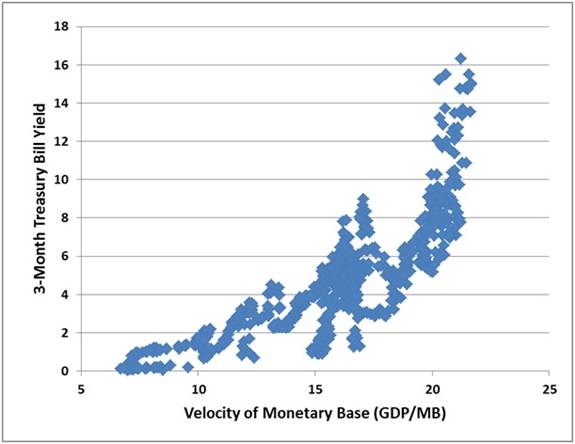
At first when the Fed makes new money and buys bonds, they increase the price of bonds, which means they lower the interest rate. Hussman's data shows this lowers the velocity of money. The lower velocity can compensate for the increased quantity of money so that often new money does not cause inflation right away.
The equation of exchange can be used with whichever definition of money supply you want to use (base money, M1, M2, etc). It is most clear that inflation will come if we use base money as our definition of the money supply. The base money supply has gone up by around a factor of 4 in about 5 years.

Since we have so far avoided inflation, the velocity of base money must have gone down by about a factor of 4 during this same period. The way this happened is that most of the new base money the Fed has made has just sat still in the Fed as excess reserves. This huge amount of non-moving money lowers the overall average velocity of money. If you think about it, it makes sense that making new money that does not leave the Fed should not cause inflation. Paying higher interest on excess reserves than short term bonds were paying was Bernanke's great new trick to hide a few trillion dollars out in the open.

However, now interest rates are going up. From Hussman we should now expect the velocity of money to go up. From the simplified equation of exchange, when the velocity of money and the money supply are both going up we should expect inflation.

As interest rates return to normal levels, the velocity of money will also return to normal levels. Then we will have 4 times the money supply and a normal velocity of money. By the simplified equation of exchange, we will then have 4 times the price level. We will have very high inflation.
You may be wondering, "why can't the Fed hold interest rates down forever?". Good question. If inflation is higher than the interest rate, then everyone and their brother can make money by borrowing and buying random stuff. To hold rates down the Fed would have to make an ever increasing amount of money, resulting in ever increasing inflation and ever increasing borrowing. The Fed seems interested in tapering their money creation which will mean letting interest rates go up. Japan, at least for the moment, seems to have chosen to try to hold interest rates down no matter how much money creation it takes. Once government debt and deficit are out of control, there is no good path for the central bank.
For the velocity of money to return to normal, it is reasonable to expect the excess reserves at the Fed will enter the real economy. There are those who think these excess reserves are somehow trapped but a bank with excess reserves can send an armored truck to the Fed and withdraw paper Federal Reserve Notes with no restrictions on them. This could happen at any time and possibly very suddenly. A couple trillion dollars suddenly flowing into the real economy would clearly result in high inflation.
Even Krugman has said that increasing the money supply is only safe when interest rates are near the zero lower bound. With interest rates going up, even by Krugman's logic, we should expect inflation.
Here is another way to look at it. From 1913 to 2007 the Fed made about $800 billion in new money total. Since then it makes around that much each year. Nearly 94 years worth of money every 12 months. In this environment, one should expect to see "too much money chasing too few goods".
Another way to look at it. In order to not cause inflation the central bank would need to be able to withdraw all the new money they created. There is just no way this can happen. Interest rates would shoot up, the value of the bonds the Fed held would crash, and they could not sell them for enough to withdraw as much money as they created.
High inflation will come. It is just a question of when.
Prize for historical example of 4x on monetary base and low-inflation
There are more than 100 cases where rapid monetization seems to have resulted in hyperinflation (using 26% cutoff). I am looking for one good example where it did not.I will pay $100 US by paypal to the first person to comment below about a case where a central bank increased the monetary base by a factor of 4 or more by buying government bonds in 5 years or less and did not get at least double digit inflation sometime during that time or the 5 years after. Must provide links to reliable info on base money growth and subsequent inflation.
This has to be for an established central bank, not a new one or a new currency at an old one (currency and bank around for at least 10 years prior to 4x period). It must be expanding the monetary base by buying up government bonds for that country (like US, UK, and Japan are doing). I am looking for a situation where a central bank did something similar to what the US has done in the last 5 years but that did not get high inflation.
Note one round of this has been won as of 1/5/14 (see comments) but I had not specified that the 4x expansion had to be from monetization which is in the current rules.
All
it would take is for one case where the equation of exchange did not
work. One time where the interest rates and inflation rates went up
substantially but the velocity of money did not. One historical case
where a central bank bought up half of a government debt that was more
than 100% of GNP, using new made money, without getting serious
inflation in the next 10 years. Maybe that is your answer, 10 years.
But I don’t think it has ever happened in history and there are many
many many times where lots of new money caused inflation down the road.
You have to think “this time is different” to not expect inflation at
some point. Doubt it very much.
Read more at http://pragcap.com/my-favorite-posts-from-2013#p4TCJp3CbFyzp1OI.99
Read more at http://pragcap.com/my-favorite-posts-from-2013#p4TCJp3CbFyzp1OI.99
All
it would take is for one case where the equation of exchange did not
work. One time where the interest rates and inflation rates went up
substantially but the velocity of money did not. One historical case
where a central bank bought up half of a government debt that was more
than 100% of GNP, using new made money, without getting serious
inflation in the next 10 years. Maybe that is your answer, 10 years.
But I don’t think it has ever happened in history and there are many
many many times where lots of new money caused inflation down the road.
You have to think “this time is different” to not expect inflation at
some point. Doubt it very much.
Read more at http://pragcap.com/my-favorite-posts-from-2013#p4TCJp3CbFyzp1OI.99
Read more at http://pragcap.com/my-favorite-posts-from-2013#p4TCJp3CbFyzp1OI.99
All
it would take is for one case where the equation of exchange did not
work. One time where the interest rates and inflation rates went up
substantially but the velocity of money did not. One historical case
where a central bank bought up half of a government debt that was more
than 100% of GNP, using new made money, without getting serious
inflation in the next 10 years. Maybe that is your answer, 10 years.
But I don’t think it has ever happened in history and there are many
many many times where lots of new money caused inflation down the road.
You have to think “this time is different” to not expect inflation at
some point. Doubt it very much.
Read more at http://pragcap.com/my-favorite-posts-from-2013#p4TCJp3CbFyzp1OI.99
Read more at http://pragcap.com/my-favorite-posts-from-2013#p4TCJp3CbFyzp1OI.99
Subscribe to:
Posts (Atom)
I’d love to go back and forth on this stuff, but I am pretty busy today so maybe another time. Take care.