Saturday, May 19, 2012
MMT and MMR are Religion not Science
Feynman explains the meaning of science in 63 seconds. The predictions of a theory must be compared to reality and if they do not match then the theory is wrong. Both MMT and MMR claim that making new money to buy up bonds is "just an asset swap" and not inflationary. When a government exchanges new money for debt it is called "monetizing debt". This experiment has been done in significant amounts over 100 times with significant inflation or hyperinflation being the eventual result. The theories of MMT and MMR do not match reality. They are wrong.

Saturday, May 12, 2012
Predicting the Timing of Hyperinflation
Bernholz found that debt over 80% of GNP and deficit over 40% of spending historically means a country is headed for hyperinflation. However, it may be a few years. Hyperinflation is a positive feedback loop that is sort of a slow motion panic as the population comes to realize that the currency is going down. It would be nice if we had other data or ratios that could predict the timing of the onset of this panic with higher precision. Here are some possibilities I think are worth investigating. This post should be viewed as a list of ideas for hyperinflation researchers and not as an attempt to explain things. Numbers below are just to make it easier to understand and not known values. If you have other ideas or know of investigations into how any of these would work please post in the comments.
- Central bank monetization relative to size of debt. Eventually the central bank will be monetizing everything in hyperinflation, so maybe after some level we can tell we will get hyperinflation soon. Maybe when the central bank owns 25% of the national debt then hyperinflation usually starts soon.
- Central bank monetization relative to size of deficit. Maybe when more than 50% of the deficit (new debt) is being monetized there is no turning back and when it gets over 100% people take notice and events start happening faster.
- Central bank monetizing at hyperinflation rates. If they are increasing the money supply at 5% per month then probably prices will be going up fast in the near future.
- Bond Panic. If everyone stops rolling over their bonds then the end is probably near.
- How far inflation is above interest rates. Maybe if the central bank keeps interest rates some amount below inflation for some period of time then things go bad.
- Money printing rate vs interest rate. Maybe if they are increasing the money supply by a larger percentage each month than the yearly interest rate on 10 year bonds, then they are headed for trouble.
- When interest on debt is over 10% of GNP. In one article it mentions that when interest on the national debt gets to 10% of GNP then you get a crisis.
- When debt is 15 or 20 times national taxes. If debt is 20 times taxes then at a 5% interest rate the interest on the debt would use up all the taxes.
- When interest on debt is over 40% of taxes. In one article it says that no country has gotten to where interest was more than 40% of taxes without getting hyperinflation.
- When taxes don't even cover mandatory spending. If taxes can't cover non-discretionary spending, which government can't cut, let alone interest on the debt or discretionary spending, then could be trouble.
- Rising interest rates. When interest rates are rising the interest payments on the national debt will be going up. This will increase the size of the deficit. It also means getting closer to Debt/GDP, interest/GDP, and interest/taxes numbers that might indicate trouble.
- Savings rate for the population. If people have figured out that you lose money by saving in the local currency then maybe hyperinflation is near. In hyperinflation people will convert savings into tangible objects. So maybe you can see this coming by looking at the savings rate in the local currency vs gold, foreign currencies, or tangible objects.
- How fast the price of gold is going up in that currency. If gold is going up fast maybe hyperinflation is near. For example, maybe when the price of gold in a currency triples in less than 1 year hyperinflation of that currency often follows.
- Trade deficit. If the US dollar is going to be rejected as the international currency then the trade deficit will reverse.
- Foreign Treasury holdings. The amount of treasuries held outside the US will probably start to go down just before hyperinflation really starts. It could be foreigners are the first to dump bonds and so foreigners getting out of a bond market is a good predictor of hyperinflation in general.
- Debt in foreign currency. A country that is about to get hyperinflation may find it hard to get loans in their own currency and so have to borrow in a foreign currency.
- Not enough money. If the public becomes convinced that there is "not enough money" then politicians will soon make the central bank print more.
- Velocity of money. Maybe the velocity starts to pick up ahead of time or maybe the velocity always slows down so the central bank can increase the money supply and then it starts to pick up again.
- Stealth monetization. Sometimes central banks have printed money but not told people as they think that what people don't know won't hurt them. Bad sign.
- Legislature increasing control over central bank. If politicians get control of the printing press it seems they always switch it into high gear.
- Increase in rate of printing. If they are printing faster and faster then hyperinflation is probably near. Maybe before hyperinflations the government usually buys lots of new equipment for printing money. So maybe this could be a predictor of hyperinflation.
- Third major printing of money. There was some French hyperinflation where after the third major batch of money printing it became clear to people that the money printing would be ongoing. With a QE3 that is also QE-infinity it might become clear there is no exit strategy and that they are going to keep printing huge amounts of money.
- Public realizes printing won't stop. Maybe when the public realizes the money printing won't stop is when things go bad. When large money printing starts it is usually claimed to be a temporary measure. But at some point it can become clear it is not going to stop.
- Polling Data. I suspect it is possible to develop a set of polling questions to predict when hyperinflation was coming. These could be used in countries that were at risk for hyperinflation. Hyperinflation depends on certain actions and beliefs of people that result in a positive feedback loop. A poll should be able to tell when this was about to start.
- Printing larger bills. Maybe after they start to print larger denomination bills hyperinflation is soon. Maybe if the US mints a $1 trillion coin hyperinflation would soon follow.
- After losing 99% of value. Maybe a currency is in danger after losing 99% of its original value.
- Empty shelves. When everyone runs out and buys extra food and tangible objects then hyperinflation is coming. Mises called this a "crack up boom". Maybe you can tell when there is a "crack up boom" and so tell that hyperinflation is coming soon. My guess is canned Tuna will be one of the first things to be cleaned out since it last years.
- How heavy bonds are toward short term. People seem to first move into short term bonds before they try to get out of bonds and cash. If everyone is in 3 month bonds then maybe hyperinflation is soon. If a large fraction is in 30 year bonds then probably no danger. So some measure of short term vs long term debt may predict hyperinflation.
- Bond Traders vs Investors. If the people buying bonds intend to hold them till maturity then hyperinflation is probably not coming soon. If the people buying bonds are doing so because they think the central bank is going to buy bonds at higher prices and they just want to flip the bonds, then it would seem the risk of hyperinflation is higher. The ratio of traders vs long term investors in bonds can probably help in predicting the risk of a bond collapse and hyperinflation.
- When 10% firmly believe. There is a theory that when 10% of a population believe something it will become true. So maybe you can predict hyperinflation by seeing when 10% of the population expects it.
- Black market and reduced GNP. When higher taxes, higher inflation, and price controls ravage the economy people move to barter to survive. As the government loses taxing ability they print money faster. Maybe some level of black market activity signals hyperinflation is coming.
- Risk-on Risk Off Oscillations. The risk on risk off market swings could get larger right before hyperinflation. Sort of increasing oscillations till something snaps.
- Reserve currency / Oil currency status. If countries stop using dollars for oil, international trade, or central bank reserves, the dollar would probably be in trouble.
- Deflation often happens before hyperinflation. I think of it like the tide going out before a Tsunami comes in. Maybe some measure of deflation can predict hyperinflation.
- Prices for Interest rate sensitive assets vs smaller tangibles. When interest rates are going up then big things like houses that are usually bought with loans tend to drop in price. As we get close to hyperinflation we may see the prices for food and smaller tangible things going up fast at the same time that houses and larger things are dropping in price. Maybe this can be used to predict hyperinflation.
- Necessities vs Luxuries. Hyperinflation is a very hard time where people have to struggle just to get the necessities of life. Luxury purchases go way down. So prices of necessities go up faster. Maybe looking at the market for luxuries vs necessities can help predict when hyperinflation is coming.
- Gold vs Paper as Safe Haven. Currently when there is some crisis people rush into dollars. At some point a crisis will cause a rush into gold. If we could look at how dollars and gold are used as safe havens over time we might be able to predict hyperinflation.
- Currency Controls. Often a government tries to keep people from getting out of their currency by passing new laws. This could be a tell that hyperinflation was coming.
- Price Controls. Price controls cause shortages and reduce economic activity. Lower real economic activity leads to less real taxes and more money printing. This is often part of the run up to hyperinflation.
- International Commodities. Prices for international commodities like oil, rice, sugar, etc. probably adjust faster than local prices as a currency devalues. So these probably hit hyperinflationary levels (say 26% per year) before the local CPI type index does. Something like the CRB index could be an early warning sign.
- Sudden Bank Holiday. Often when things are falling apart a government will declare a bank holiday and close all the banks. This may be too late of a hyperinflation warning to be of much use.
- Foreign exchange rate. The foreign exchange rate may go down sooner than prices go up. It can take time for the higher cost of imports and the higher price demand for exports to percolate through the whole economy. So this could give some warning.
- Price of imported goods shoots up. In Belarus in 2011 the price of imported pampers shot up before the prices of locally produced goods did. So prices on imported goods shooting up could be a warning signal.
- Propping up currency. If the central bank or government are intervening in the currency markets to prop up their currency then maybe things are about to get out of control.
- Excess Reserves going into economy. The US bank excess reserves earn interest, which really makes them just like short term Treasuries. When money comes out of these reserves, or Treasuries, into the economy the inflation is probably going to go up.
- Domino Theory. There is this widely believed myth that advanced democracies can't get hyperinflation. Once one of them does (my guess is Japan first) then others probably will follow. So any of Japan, UK, Europe getting hyperinflation probably indicates that the US hyperinflation is getting close.
- Search Frequency. Using Google Trends to see how often hyperinflation is searched might give us a clue. Or see how often the Hyperinflation FAQ is accessed. If people are really getting worried about hyperinflation we should be able to see this on the net somehow. If FAQ readers are coming from some country it might indicate trouble there.
- Simulating Hyperinflation. A simulation of hyperinflation could be adjusted to try to make it fit, as well as possible, many historical cases of hyperinflation. Once it was tuned, the current situation could then be fed in and a good estimate of when hyperinflation would hit should come out.
- Big Mac Index. Government measures of inflation often are distorted and late. The Big Mac Index may show inflation first. It is interesting that in Japan the Big Mac has gone up in price by 20%.
- Central bank viewed as funding the deficit. When popular opinion has it that the central bank is funding the government deficit, then there will be trouble. Might do polls and when this view got over some limit you might have a good predictor.
- Using Multiple Theories. Using descriptions of hyperinflation from many different theories we could make a bunch of polling questions to see when we were getting close to hyperinflation.
- Borrowing for Interest. If the government has to borrow not only for the primary deficit but also for the interest payments, then the markets might think this is too much.
- Smart Money Fleeing Country. When the smart money is getting out of a country it may be that they see the hyperinflation coming.
- Monetization equal to debt X years back. Maybe when the total monetization equals the debt from X years go (maybe 6 to 10 years or something) then you will get hyperinflation.
- Years of interest comparable to days of volatility. Maybe when 5 years of interest makes you about as much as you lose in one week of currency drop then people give up. Maybe it is 10 years vs 10 days, or some other numbers. But at some point the risk/reward is clearly that of a bad investment and people flee.
- Monthly bond loss more than yearly interest for X months. Maybe after some amount of loss on the value of the bonds compared to the yearly interest then people get fed up and leave bonds.
- Net Debt. The net debt is the debt owed by the government to the public, ignoring any bonds from one part of government to another. In the US case all the "social security fund" is just internal pretend bonds that should be ignored. It seems that Japan's 240% of GNP drops to around 100% of GNP if we just look at net debt. This would explain why they have lasted so long.
- Money supply going up fast. Maybe the current M2 measure of the money supply will go up faster right before hyperinflation starts.
Saturday, March 10, 2012
Money and Bonds
A government bond that comes due tomorrow will turn into money tomorrow, so it is not very different from money. In fact, a bond that comes due 30 days from now is still not very different from money. Most of the time money changes hands slower than once every 30 days. But a 30 year bond is very different from money. In this case someone has given up their money to the government for 30 years. They may be able to sell the bond and get some money now, but not necessarily as much as they paid for the bond. And if they do sell the bond then there is someone else who has given up money till 30 years from now. So when the government sells a bond it removes some cash from the economy for that period of time.
Imagine the government's debt was evenly spread out over bonds that came due over the next 30 years. Then in any one year at most 1/30th of the debt would come due. This is a far more secure financial position than if all the debt was in 1 year bonds that came due over the next 12 months. If interest rates go up and all the bonds have to be refinanced over the next 12 months it is as if the government has a variable rate loan where the payments can go up. If this year the public does not want to buy bonds the government would have to print for 1/30th of the debt in the first case and all of the debt in the second case, which is far more inflationary.
The Fed is currently trying "operation twist" and now talking about sterilized QE. Essentially they are buying long term bonds and selling short term bonds. They claim this is sterilizing their liquidity operation. But since a short term bond is much more like money than a long term bond it is not fully sterilizing. If they buy 30 year bonds and sell 3 month bonds then they are really only sterilizing for the next 3 months. This is 1/4th of a year out of 30, or 1/120th sterilized. Less than 1% sterilized. After that all the inflationary pressure may be released.
One of the core ideas of central banking is that they should only buy short term debt that is sure to be paid back. If they do this then they can always withdraw any money they added earlier. In this case they always have the ability to prevent inflation. However, the market price of a 30 year bond could drop in half if the interest rate goes up a few points. So if the Fed tried to sell a 30 year bond after the interest rates start to go up they might only withdraw half of the money they added. If the interest rates go up alot they might only be able to withdraw 1/10th of the money they added when they bought the 30 year bond. If the value of a 3 month bond drops they can just wait out the 3 months and still get the full value back. But they may not have the option to wait 30 years if inflation starts to pick up. So buying long term bonds runs the risk of adding money that can not later be withdrawn.
The government would be safer to move as much debt into 30 year bonds as they can. Instead the Fed is getting people out of long term bonds and into short term bonds. This puts the government in a more dangerous position. Moving to short term bonds is part of the setup for hyperinflation.
If people have 3 month bonds, then if they decide the dollar is losing value they can get their cash in 3 months and never buy bonds again. If everyone is in short term bonds then everyone can get out in a short period of time. In this case the government has to print money like crazy to pay off all the bonds (ok really the Fed will be the only buyer of bonds and they are using new money). This is the recipe for hyperinflation.
Imagine the government's debt was evenly spread out over bonds that came due over the next 30 years. Then in any one year at most 1/30th of the debt would come due. This is a far more secure financial position than if all the debt was in 1 year bonds that came due over the next 12 months. If interest rates go up and all the bonds have to be refinanced over the next 12 months it is as if the government has a variable rate loan where the payments can go up. If this year the public does not want to buy bonds the government would have to print for 1/30th of the debt in the first case and all of the debt in the second case, which is far more inflationary.
The Fed is currently trying "operation twist" and now talking about sterilized QE. Essentially they are buying long term bonds and selling short term bonds. They claim this is sterilizing their liquidity operation. But since a short term bond is much more like money than a long term bond it is not fully sterilizing. If they buy 30 year bonds and sell 3 month bonds then they are really only sterilizing for the next 3 months. This is 1/4th of a year out of 30, or 1/120th sterilized. Less than 1% sterilized. After that all the inflationary pressure may be released.
One of the core ideas of central banking is that they should only buy short term debt that is sure to be paid back. If they do this then they can always withdraw any money they added earlier. In this case they always have the ability to prevent inflation. However, the market price of a 30 year bond could drop in half if the interest rate goes up a few points. So if the Fed tried to sell a 30 year bond after the interest rates start to go up they might only withdraw half of the money they added. If the interest rates go up alot they might only be able to withdraw 1/10th of the money they added when they bought the 30 year bond. If the value of a 3 month bond drops they can just wait out the 3 months and still get the full value back. But they may not have the option to wait 30 years if inflation starts to pick up. So buying long term bonds runs the risk of adding money that can not later be withdrawn.
The government would be safer to move as much debt into 30 year bonds as they can. Instead the Fed is getting people out of long term bonds and into short term bonds. This puts the government in a more dangerous position. Moving to short term bonds is part of the setup for hyperinflation.
If people have 3 month bonds, then if they decide the dollar is losing value they can get their cash in 3 months and never buy bonds again. If everyone is in short term bonds then everyone can get out in a short period of time. In this case the government has to print money like crazy to pay off all the bonds (ok really the Fed will be the only buyer of bonds and they are using new money). This is the recipe for hyperinflation.
Friday, March 2, 2012
How can a government run out of money?
The MMT and MMR folks are fond of saying that "a government that is a currency issuer can not run out of money". But this is not true! Money is any object or record that is generally accepted as payment for goods and services and repayment of debts. After hyperinflation their currency is no longer accepted as money. They can still print pieces of paper but nobody uses them for commerce any more. So the accurate statement is that "a government that is a currency issuer can not run out of currency". Any government, even one that prints currency, can run out of money.
Monday, January 23, 2012
Gold vs Silver
Gold works best for central banks issuing paper money backed by a commodity. It is easier to transfer really large amounts of value around.
However, for coins gold is just too valuable for everyday transactions. A very small 1/10th oz coin is $170 worth of gold. You can't really make them smaller than this and still have them feel like a coin. So if you go to the store to buy some food and give them your $170 coin, how will they make change for you? So if you want to use coins with a real intrinsic value, gold is just too valuable. Through history silver coins were the main money.
In the 1970s two brothers were able to buy so much silver and silver contracts that they drove the price up to about $50. Today there is at least 10 times as much money out there but there is actually less silver above ground today. For the last 40 years silver has not been used much as money and has been used up in film and other things. So there are many more people, companies, or countries that if they wanted to could buy up so much silver that they drove the price up far higher than back in the 1970s.
If we get hyperinflation and people lose faith in paper money in general they will want coins that they can use for trade. By that point the value of gold will be far higher than today compared to food. So it will work even less well than it does today. Silver will make for far more practical coins.
So if we get hyperinflation in several paper currencies, like the dollar, the yen, and the pound, and maybe the Euro, then silver will shoot up in value even more than gold.
However, for coins gold is just too valuable for everyday transactions. A very small 1/10th oz coin is $170 worth of gold. You can't really make them smaller than this and still have them feel like a coin. So if you go to the store to buy some food and give them your $170 coin, how will they make change for you? So if you want to use coins with a real intrinsic value, gold is just too valuable. Through history silver coins were the main money.
In the 1970s two brothers were able to buy so much silver and silver contracts that they drove the price up to about $50. Today there is at least 10 times as much money out there but there is actually less silver above ground today. For the last 40 years silver has not been used much as money and has been used up in film and other things. So there are many more people, companies, or countries that if they wanted to could buy up so much silver that they drove the price up far higher than back in the 1970s.
If we get hyperinflation and people lose faith in paper money in general they will want coins that they can use for trade. By that point the value of gold will be far higher than today compared to food. So it will work even less well than it does today. Silver will make for far more practical coins.
So if we get hyperinflation in several paper currencies, like the dollar, the yen, and the pound, and maybe the Euro, then silver will shoot up in value even more than gold.
Monday, September 12, 2011
Is this the beginning of the end for the dollar?
The US runs a trade deficit and normally the rest of the world increases their Treasury holdings every month. However, last month the Foreign treasury holdings went down $17 billion.
Part of the usual hyperinflation situation is that people stop rolling over bonds and get their cash as the bonds come due, and the central bank ramps up cash production. So I have been expecting this. Some people like Pettis and Mish have claimed that mathematically the world has to keep buying Treasuries, but I don't think that is true at all. If the world stops buying, then the Fed will buy more Treasuries with newly made money. The more the Fed makes money the less people will want to hold US debt. The less people want to hold US debt, the more the Fed will have to buy with newly made money so that the US government can continue to cover their expenses. This is the kind of positive feedback loop that drives hyperinflation till the currency is destroyed.
So I will be watching the Treasury report this week with great interest. A new report comes out on the 15th or 16th. If Foreign holdings drop again, I think it will be very significant news. I think they will drop.
Part of the usual hyperinflation situation is that people stop rolling over bonds and get their cash as the bonds come due, and the central bank ramps up cash production. So I have been expecting this. Some people like Pettis and Mish have claimed that mathematically the world has to keep buying Treasuries, but I don't think that is true at all. If the world stops buying, then the Fed will buy more Treasuries with newly made money. The more the Fed makes money the less people will want to hold US debt. The less people want to hold US debt, the more the Fed will have to buy with newly made money so that the US government can continue to cover their expenses. This is the kind of positive feedback loop that drives hyperinflation till the currency is destroyed.
So I will be watching the Treasury report this week with great interest. A new report comes out on the 15th or 16th. If Foreign holdings drop again, I think it will be very significant news. I think they will drop.
Monday, August 1, 2011
Gold price and US debt
As the debt limit and debt have gone up, so has the price of gold. When the debt doubled gold went up by about a factor of 4. They are raising the debt limit by $2.4 trillion from $14.3 trillion, or about 17%. So one reasonable guess is that gold will go up by 1.17^2 or 1.3689. So from $1,650 that would get to $2,259.


Tuesday, June 14, 2011
Fed Funding Gov Deficit
Many people understand that a government can not just print and spend money for most of its expenses or you get hyperinflation like Zimbabwe did when they tried it. In fact, many people think Zimbabwe was stupid to even try that.
Many people realize that the Fed creating money and handing it to the US government for bonds is uncomfortably close to Zimbabwe's situation. So many are expecting that this Quantitative Easing will stop. However, there is a puzzle as to who else would put $100 billion a month into US government debt.
One popular theory is that banks will borrow money at 0.25% from the Fed and buy US government bonds at higher rates like 1.5% for 5 year bonds. So the theory goes that the banks are funding the government, not the Fed. This is foolish as it is really still newly created money from the Fed that is funding the government.
People think that Zimbabwe just printed money and spent it. But Zimbabwe had a central bank that financed the government just like the US. At some point it became clear that the "loans to the government" were just an accounting fiction and what was really going on was they were printing money and spending it. The same will become clear in the US. At some point in the future people will think the US was stupid to try it.
Many people realize that the Fed creating money and handing it to the US government for bonds is uncomfortably close to Zimbabwe's situation. So many are expecting that this Quantitative Easing will stop. However, there is a puzzle as to who else would put $100 billion a month into US government debt.
One popular theory is that banks will borrow money at 0.25% from the Fed and buy US government bonds at higher rates like 1.5% for 5 year bonds. So the theory goes that the banks are funding the government, not the Fed. This is foolish as it is really still newly created money from the Fed that is funding the government.
People think that Zimbabwe just printed money and spent it. But Zimbabwe had a central bank that financed the government just like the US. At some point it became clear that the "loans to the government" were just an accounting fiction and what was really going on was they were printing money and spending it. The same will become clear in the US. At some point in the future people will think the US was stupid to try it.
Saturday, June 11, 2011
Is Debt Situation Like After WWII?
There is an interesting paper that claims the way debt was brought under control after WWII was "financial repression". The idea is that government debt levels after WWII were about what they are now and the way they were brought under control was by government controlling private finance and inflation. The expectation is that austerity and hyperinflation are less acceptable choices, so we should expect governments to use financial repression to flece their populations.
This basic theory is bogus. The main reason governments were able to cope with such high debt levels back then is that the high spending levels generating the high debt were due to the war. Back then more than 3/4ths of the government budget was for the war so it was easy to cut government spending in half once the war was over. Once the spending problem was solved the debt level was not a killer.
Today there is no equivalent way to cut government spending in half like there was after WWII. Today most of the budget is mandatory spending. So even though the US debt level is comparable to after WWII, the US debt level now is a far more difficult and dangerous situation than it was back then.
Investors after WWII understood a history of hundreds of years of gold and silver money. They did not have much understanding of paper money and inflation. Back then many could be fooled into owning government debt that paid an interest rate lower than the inflation rate. After the high inflation of the 1970s investors understand inflation better. Today, with the Internet, word would get around very fast. There is just no way that same trick used in "financial repression" could work for 30 years now like it did back then.
FredGraph does not go back before 1947 for government receipts and expenditures. But here is 1947 to 1950:

The government had expenses of less than $40 billion and income of over that. If the US government today had budget surplus then the debt situation would be comparable. However, it has a huge deficit and no credible plan to get it under control, so the situation is very different.

This basic theory is bogus. The main reason governments were able to cope with such high debt levels back then is that the high spending levels generating the high debt were due to the war. Back then more than 3/4ths of the government budget was for the war so it was easy to cut government spending in half once the war was over. Once the spending problem was solved the debt level was not a killer.
Today there is no equivalent way to cut government spending in half like there was after WWII. Today most of the budget is mandatory spending. So even though the US debt level is comparable to after WWII, the US debt level now is a far more difficult and dangerous situation than it was back then.
Investors after WWII understood a history of hundreds of years of gold and silver money. They did not have much understanding of paper money and inflation. Back then many could be fooled into owning government debt that paid an interest rate lower than the inflation rate. After the high inflation of the 1970s investors understand inflation better. Today, with the Internet, word would get around very fast. There is just no way that same trick used in "financial repression" could work for 30 years now like it did back then.
FredGraph does not go back before 1947 for government receipts and expenditures. But here is 1947 to 1950:
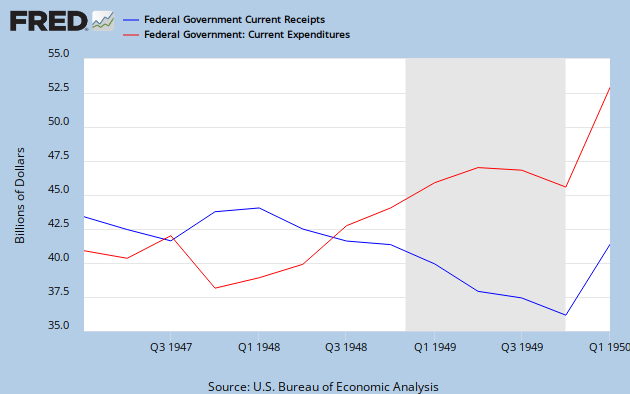
The government had expenses of less than $40 billion and income of over that. If the US government today had budget surplus then the debt situation would be comparable. However, it has a huge deficit and no credible plan to get it under control, so the situation is very different.
Monday, May 16, 2011
We are all deflationists now
There is a big inflation vs deflation debate. But really both sides believe in deflation. Deflationists believe in deflation when measuring prices in paper money. The inflationists believe in deflation when measuring prices in terms of gold coins.
The meaning of the historical record is not obvious. In the early 1930s the US was sort of on paper money and sort of 40% gold backed. So do you count the deflation in this time as deflation in terms of gold or deflation in terms of fiat money? I think there is a big clue. The way they ended deflation was by getting off the gold standard and making it illegal for people to own gold.
If you look at house prices measured in ounces of gold they are down by about a factor of 4. That is some deflation.

The meaning of the historical record is not obvious. In the early 1930s the US was sort of on paper money and sort of 40% gold backed. So do you count the deflation in this time as deflation in terms of gold or deflation in terms of fiat money? I think there is a big clue. The way they ended deflation was by getting off the gold standard and making it illegal for people to own gold.
If you look at house prices measured in ounces of gold they are down by about a factor of 4. That is some deflation.
Subscribe to:
Posts (Atom)